Wine App for Restaurants: Digital Sommelier Tools Compared
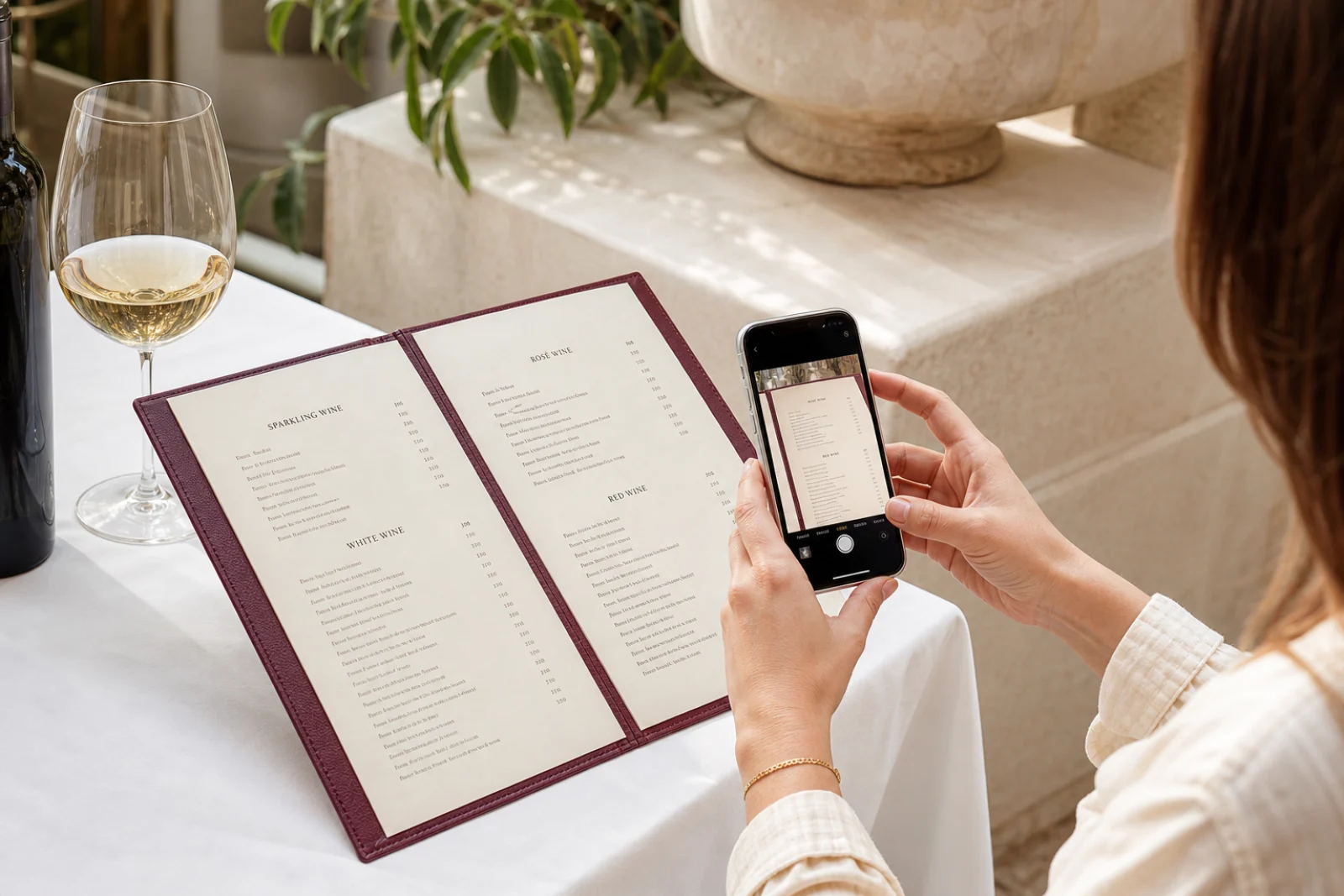
The hospitality industry is changing fast. Guests increasingly expect personalized wine advice, but a full-time sommelier is financially out of reach for most restaurants. Digital sommelier tools fill that gap -- but which one fits your establishment?
We compare three approaches: the traditional sommelier, modern wine apps, and POS integrations. For each option, we examine the costs, ease of use, quality of advice, and impact on your wine revenue. So you can make an informed decision.
The Problem: Wine Advice Without a Sommelier
Only a fraction of restaurants employ a trained sommelier. The rest rely on wait staff who "know a bit about wine" -- or honestly, often do not. The result is predictable:
- Guests choose the second-cheapest wine -- the classic restaurant behavior when nobody advises
- Expensive wines sit unsold -- without guidance, nobody takes the leap
- Guests lack guidance -- without clear explanation, choosing a suitable wine is difficult
- The wine list becomes a static document -- without someone actively promoting it
Digital tools solve this by making sommelier-level knowledge available to every staff member. But not every tool does it equally well.
Option 1: The Traditional Sommelier
Let us be honest: a good sommelier is irreplaceable for fine dining. The personal interaction, reading the guest, the theatrical element of presenting and serving wine -- no app can replicate that. But the costs are substantial.
Costs: these vary by labour market, experience, schedule and training. Request a current quote for personal service and do not compare on price alone: personal hospitality and a digital analysis fulfil different roles.
Advantages:
- Personal guest interaction -- irreplaceable for the experience
- Flexible advice that adapts to the guest
- Can curate and manage the wine list
- Can explain the list and guide each guest personally
Disadvantages:
- High fixed costs, even during quiet periods
- Knowledge tied to a person -- if they leave, you lose the expertise
- Not scalable -- a sommelier can only serve a limited number of tables
Option 2: SommelierX Guest Sommelier (QR code on the menu)
The SommelierX guest sommelier is made for restaurants that do not have a full-time sommelier but want to offer professional wine advice at the table. It works fundamentally differently from generic wine apps: the advice comes exclusively from your own wine list.
Cost: EUR 29 per month, cancel monthly. No setup fee; a free wine list scan first.
Advantages:
- calculated -- not opinions, but calculated matches based on flavor variables
- Instantly deployable -- no training needed, staff can use it right away
- Scalable -- works for 10 tables or 100, at no extra cost
- Staff-independent -- knowledge lives in the system, not in a person
- Low, predictable cost -- EUR 29 per month, stop whenever you like
Disadvantages:
- No personal guest interaction -- it is a tool for staff, not a replacement for table service
- Works based on the wine list -- frequent changes require re-scanning
- No wine purchasing advice -- it optimizes what is already on the list
Option 3: POS Integrations and Digital Wine Lists
Some restaurants opt for POS systems (point-of-sale) with built-in wine features, or digital wine lists via QR codes. These tools focus more on presentation and the ordering process than on pairing advice.
Costs: Varies widely. QR-code wine lists: $30-100 per month. POS integrations: often part of the existing system.
Advantages:
- Guest-facing experience -- the guest can browse the wine list at their own pace
- Real-time updates -- price and availability changes instantly visible
- Data insights -- which wines are viewed and ordered
Disadvantages:
- No pairing advice -- they display the list but do not help with the choice
- Monthly costs that add up
- Can feel impersonal -- not every guest wants an iPad instead of a sommelier
- No scientific basis for recommendations
The Comparison
| Criterion | Sommelier | Guest sommelier (QR) | POS / QR List |
|---|---|---|---|
| Cost (year 1) | $50,000-80,000 | EUR 348 (29 per month) | $360-1,200 |
| Food pairing quality | Excellent | Excellent | None |
| Guest interaction | Personal | Via staff | Digital |
| Scalability | Limited | Unlimited | Unlimited |
| Implementation time | Weeks-months | Minutes | Days |
| Staff needed | Yes (specialist) | No | No |
When to Choose What
The choice depends on your restaurant type and budget:
Fine dining (revenue > $500,000/year)
Invest in a sommelier. The personal experience is an essential part of the service here. Use the guest sommelier as a complement for the tables and moments when the sommelier is unavailable.
Bistro, brasserie, mid-range (revenue $150,000-500,000/year)
The sweet spot for the guest sommelier. You want to offer professional wine advice but do not have the budget for a full-time sommelier. Combine the QR code on the menu with an annual wine consultant session for list curation.
Cafe, casual dining
A plain QR-code wine list may suffice for presentation. Consider the guest sommelier if you want to differentiate with advice per dish.
Measure what the wine tool delivers
A revenue increase can never be guaranteed in advance. Measure the same indicators before and after implementation: wine revenue per cover, the share of tables ordering wine, average bottle price and the number of questions staff can answer independently.
The SommelierX guest sommelier costs EUR 29 per month, cancel monthly. Compare that investment with your own wine revenue per table to build a realistic business case for your restaurant rather than relying on a generic ROI promise.
Frequently Asked Questions
How much does a digital sommelier cost for a restaurant?
Costs depend on the chosen service and local labour market. Personal service and a digital sommelier do not fulfil the same role. The SommelierX guest sommelier costs EUR 29 per month and gives guests advice from your own wine list at the table.
Can an app replace a real sommelier in a restaurant?
For fine dining where the wine experience is a core part of the service: no. But for bistros, brasseries, and mid-range restaurants that cannot afford a full-time sommelier: absolutely. A digital tool gives staff the knowledge to make better wine recommendations.
How does the SommelierX guest sommelier work for restaurants?
You photograph your wine list; we read every wine. Guests scan a QR code on the menu, pick their dish and see which wines from your list fit. Your team gets the pairing matrix as a service card. EUR 29 per month, cancel monthly.
Put your wine list on the menu with a QR code
Guests scan, pick their dish and see which wine from your list fits — in their own language. Start with the free wine list scan: you get an e-mail showing how many dishes your list covers and where the gaps are.
Free wine list scanWant to learn more? Check out our articles on sommelier costs and alternatives and creating the right patio wine list.